
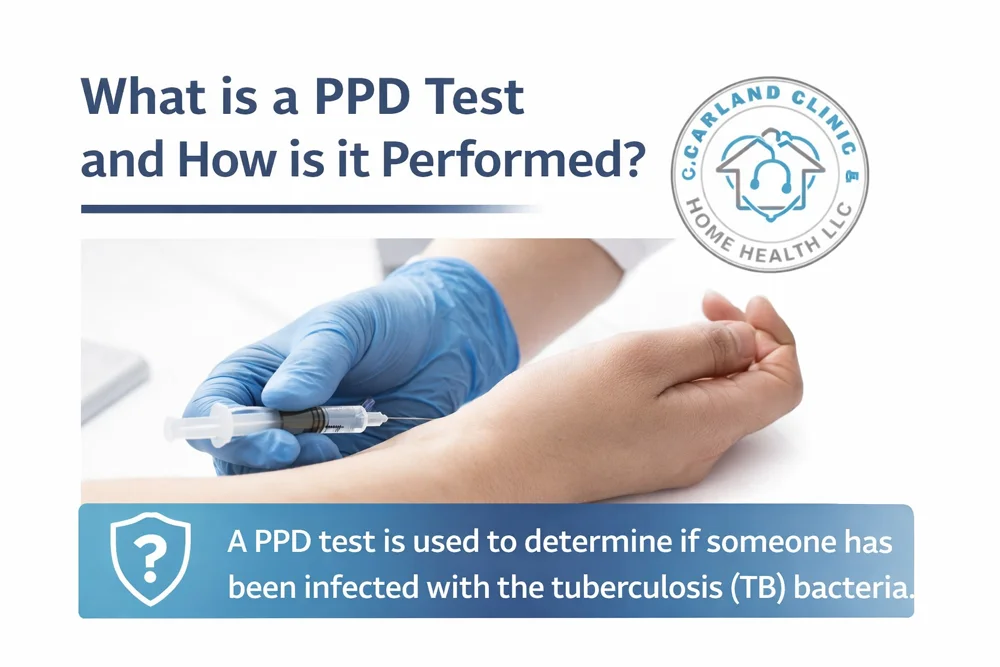
In this guide, we will walk through the PPD test step by step, explaining the science behind the screening and what you can expect at Careland Clinic or your local provider.
Tuberculosis, commonly referred to as TB, is a serious infectious disease caused by the bacterium Mycobacterium tuberculosis. Unlike many other illnesses, TB primarily targets the lungs, although it can attack any part of the body, such as the kidneys, spine, and brain. It is an airborne pathogen, meaning it spreads through the microscopic droplets released when an infected person coughs, sneezes, or speaks.
Because it is airborne, TB is highly contagious in close quarters environments. Think of it as a silent traveler; it moves between people quietly, often without the host even realizing they are carrying a potentially life threatening bacteria.
TB doesn’t always present with immediate symptoms. Medical professionals categorize the infection into two types:
This is why tuberculosis screening in Newnan and across the globe is a cornerstone of preventive medicine. By identifying latent TB through a PPD test, healthcare providers can offer treatment that prevents the disease from ever becoming active, protecting both the individual and the community.
The Purified Protein Derivative (PPD) test is a diagnostic tool used to determine if a person has been exposed to the bacteria that cause tuberculosis. It is important to note that the PPD test is not a vaccine nor does it contain live bacteria. It uses a small, sterile protein extract derived from the TB bacteria to trigger a response from your immune system.
The test measures your delayed type hypersensitivity response. If your body has encountered TB before, your immune cells (specifically T cells) will recognize the proteins in the PPD solution. Within 48 to 72 hours, these cells will rush to the injection site, causing a measurable skin reaction.
In the medical field, you might hear this test referred to by several names. They all refer to the same procedure:
Regular visits help catch small issues before they turn into big, expensive, or dangerous problems. This proactive approach includes:
The TB skin test procedure is a two visit process. Understanding each step can help alleviate any needle anxiety you may have.
This is the most critical part of the process. You must return to the clinic within the PPD test 48–72 hour window.
When you return for your reading, a trained professional will not just look at the arm; they will feel it. They are looking for induration a hard, dense, raised area of skin.
It is a common misconception that redness (erythema) equals a positive result. Redness is often just a minor irritation. The provider will use a specialized ruler to measure the diameter of the hardened area in millimeters (mm).
Some employers, particularly in hospitals and long term care facilities, require a 2 step PPD test. This is a specialized protocol designed to “boost” the immune system’s memory.
Sometimes, if a person was infected with TB many years ago, their immune system might not react to a single PPD test a (false negative). However, the first test acts as a reminder. When a second test is given 1 to 3 weeks later, the immune system is primed and will react if the bacteria are present.
The PPD test is incredibly safe and has been used for decades. Because it does not contain live bacteria, you cannot “catch” TB from the test.
While the skin test is the traditional method, there is a modern alternative known as the IGRA (Interferon Gamma Release Assay), or TB blood test.
At Careland Clinic, we can help you determine whether the PPD skin test or a TB blood test is the most appropriate and cost effective option for your specific needs.
The PPD test may be a minor inconvenience, involving a small pinch and a return visit, but its impact on public health is massive. It is one of the most effective tools we have to stop tuberculosis in its tracks before it can spread through our schools, workplaces, and homes.
Whether you are starting a new job, heading off to college, or simply staying on top of your health, tuberculosis screening in Newnan provides you with the peace of mind that you are protecting yourself and those around you.
Don’t wait until you have symptoms. If you need a PPD test for employment, school, or personal health, schedule an appointment today. A simple test today is the best way to ensure a healthy tomorrow.
Avoid scratching the area or covering it with tight bandages. Keep it clean and dry.
Yes, you can shower. Just don’t scrub the injection site.
It’s reliable when performed and read correctly within 48–72 hours.
Your provider may recommend a chest X-ray or further evaluation to check for active TB.
Some healthcare workers and high-risk individuals may need annual testing, depending on workplace policies.