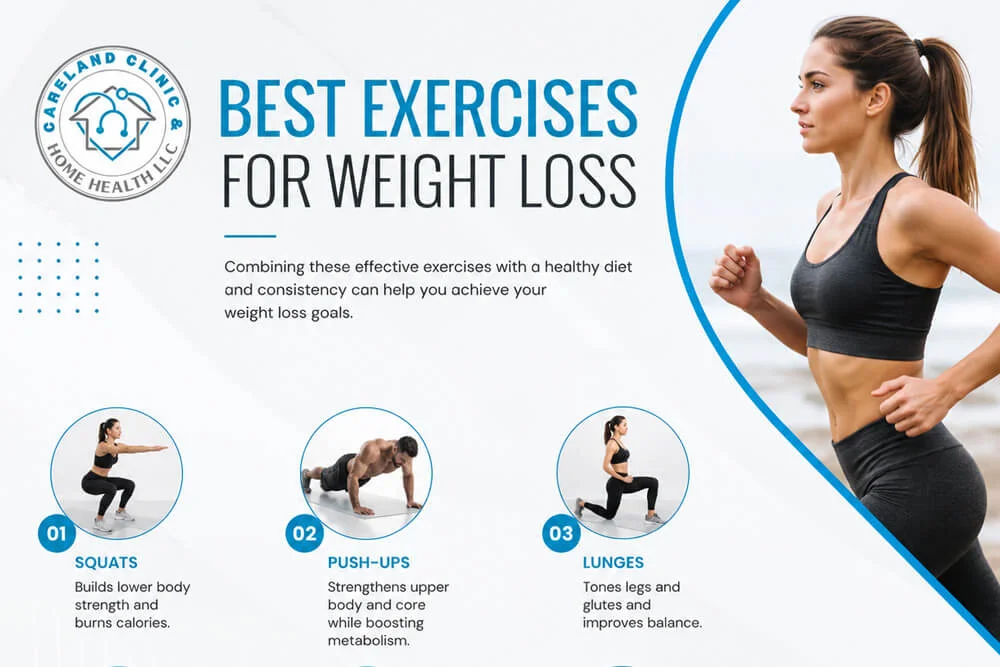
Some swear by heavy weightlifting, while others insist that hours of sweat inducing cardio are the only way to melt body fat. From a medical standpoint, healthy weight loss is not just about forcing your body to burn calories it is about altering your metabolic health, preserving lean muscle tissue, and creating a sustainable energy deficit. To achieve long term success, you need a balanced combination of exercises that target different energy systems in the body.
If efficiency is your primary goal, High Intensity Interval Training (HIIT) stands at the top of medical recommendations for fat loss. HIIT involves short bursts of intense exercise alternated with low intensity recovery periods. A typical session lasts only 15 to 30 minutes, making it highly practical for busy lifestyles.
HIIT triggers a physiological phenomenon known as EPOC (Excess Post Exercise Oxygen Consumption), commonly referred to as the afterburn effect. After a high intensity session, your body requires more oxygen to restore itself to its resting state. This means your metabolism remains elevated, and you continue to burn calories for hours after your workout is finished. Furthermore, studies show that HIIT specifically targets visceral fat the dangerous fat stored around internal organs.
Many people mistakenly skip the weight room when trying to lose weight, fearing that lifting weights will make them bulky. Professionally, this is a major misconception. Weight training is an absolute necessity for sustainable fat loss.
When you restrict calories to lose weight, your body naturally breaks down both fat and muscle tissue for energy. Losing muscle lowers your Basal Metabolic Rate (BMR) the number of calories your body burns at rest. Resistance training signals your body to preserve muscle mass, ensuring that the weight you lose comes almost exclusively from fat stores. Muscle tissue is metabolically active the more lean muscle you have, the more calories your body burns naturally every single day.
While high intensity gets a lot of attention, steady state cardio often referred to as Zone 2 training remains a cornerstone of cardiovascular and metabolic health. This includes activities like brisk walking, cycling, or swimming at a moderate, conversational pace.
During Zone 2 exercise, your heart rate stays at roughly 60% to 70% of its maximum. At this specific intensity, your cellular mitochondria primarily utilize stored fatty acids (fat) as fuel rather than carbohydrates (glycogen). It builds your aerobic base, improves insulin sensitivity, and lowers resting blood pressure without putting excessive stress on your central nervous system or joints.
Medical Rule of Thumb: To estimate your Zone 2 heart rate range, calculate:
(220 – Your Age) x 0.60 to (220 – Your Age) * 0.70
Sticking to just one form of exercise often leads to a physical plateau and mental burnout. Functional fitness and cross training combine elements of mobility, balance, cardio, and strength into dynamic routines.
Cross training forces your body to adapt to unpredictable movement patterns, which burns more energy than performing highly repetitive movements. It prevents overuse injuries by distributing physical stress across different joints and muscle groups, ensuring you can stay consistent with your routine without facing setbacks.
| Workout Type | Frequency | Main Benefit |
|---|---|---|
| Strength Training | 3 days / week | Preserves muscle mass & boosts BMR |
| HIIT Session | 1-2 days / week | Maximizes calorie burn & triggers EPOC |
| Zone 2 Cardio (Walking) | Daily (30-45 mins) | Uses fat as primary fuel & improves heart health |
| Rest & Active Recovery | 1-2 days / week | Repairs tissues & balances stress hormones |
Whether you are looking to manage your weight to combat chronic conditions, recover your mobility, or establish a safe physical routine under expert guidance, professional care makes all the difference. At CCHH Care, we understand that health is deeply personal. As a trusted community provider specializing in comprehensive health, supportive services, and compassionate transitional care, we are dedicated to helping you live safely, healthily, and optimally.
Your journey toward sustainable vitality doesn’t have to be done alone. Visit Careland Clinic and Home Health today to discover resources, professional guidance, and community connected care tailored to support your long term health goals.
Medically speaking, you cannot spot reduce fat from a specific area of the body. Exercises like crunches strengthen the abdominal muscles underneath, but do not selectively burn the fat covering them. To lose belly fat, you must reduce overall body fat percentage. HIIT and Strength Training are the most effective options because they elevate your systemic metabolic rate and target visceral fat deep within the abdomen.
While exercise is crucial for physical health, cardiovascular fitness, and muscle retention, it is very difficult to lose significant weight through exercise alone. It is far easier to consume 500 calories than it is to burn 500 calories through movement. Successful, long-term weight management requires combining an active lifestyle with a nutritionally balanced, calorie-controlled diet.
Both serve vital, distinct roles. Cardio (like running or swimming) burns more calories during the actual workout session. Weightlifting, however, builds muscle mass which allows your body to burn more calories at rest throughout the day. For the ultimate medical approach to weight loss, a combination of both is superior to choosing just one.
For safe and sustainable fat loss, medical guidelines recommend aiming for 150 to 300 minutes of moderate-intensity exercise, or 75 to 150 minutes of vigorous-intensity exercise per week. This typically translates into 4 to 5 active days per week, balancing resistance routines with cardiovascular work and adequate rest.
If you suffer from joint issues, arthritis, or carry significant excess weight, high impact activities like running can cause injury. Low impact alternatives are highly recommended. Swimming, water aerobics, stationary cycling, and using an elliptical machine allow you to elevate your heart rate and burn calories while completely protecting your weight bearing joints.